| In Oracle, Ready to Pay | YES! |
|---|---|
| Name | Ashley Wilson Fellers |
| Phone | 540-355-6038 |
| Email hidden; Javascript is required. | |
| Name of Work (TBD or Untitled are okay) | Tinker Creek Greenway: Lines & Liminal Spaces |
| Please upload a JPG of your work in progress | 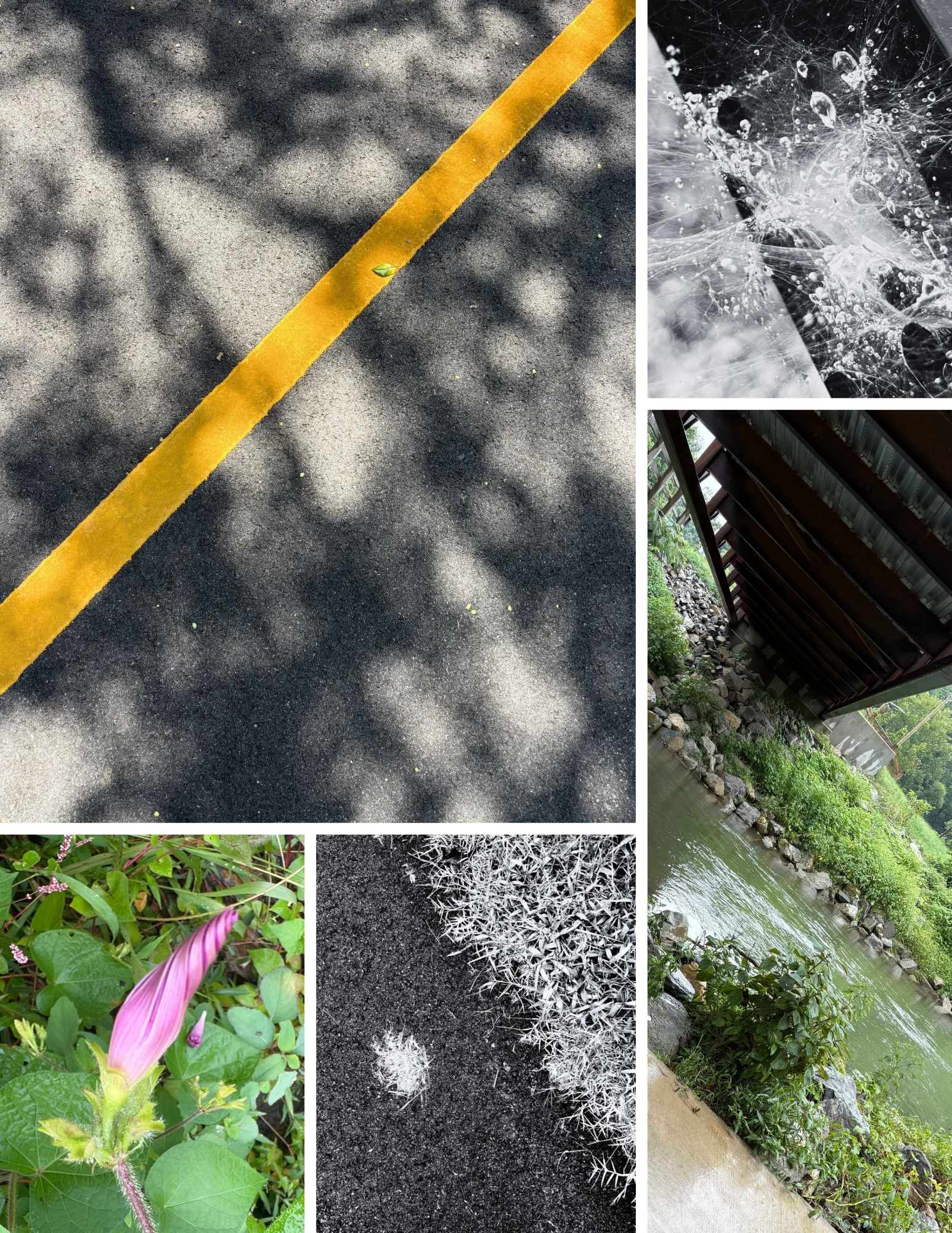 |
| Please upload a JPG or PNG of a picture of you that we can use in the show. We prefer a headshot or something that clearly shows your face. Please make sure it’s high enough resolution for print. |  |
| May we potentially use your work in progress image as part of promotional activities? | Yes, please do. |
| Describe the work including planned media, size and presentation format. (All art forms are accepted for this call, but there must be a physical representation of the work ready for display. Most often this is a framed and ready-to-hang two dimensional image.) | For this work, I’ll be creating a tiny “gallery” of contemplative photography, presented in miniature gold plein-air-style frames. Each frame will contain an image measuring four inches by four inches. A total of nine to sixteen frames will be presented (I am still collecting images), and the installation will be deliberately curated to highlight contrast, tension and cohesion (nature and humanity, water and rock, hard lines and soft curves, etc.) … and ultimately to invite contemplation, right within the municipal-building hallway. I am able to provide a carefully labeled template for installation (it will fit comfortably within the 24X36 requirements) or perform the installation myself, as is most convenient for the committee. Hangers/adhesives will be provided that do not damage walls. |
| Describe your contemplative practice in relation to the work so far. | In the beginning of this project, I wondered what shape my work might take. Would I photograph? Sketch? Paint in plein air? A combination of those things? But I felt myself called back, over and over, to contemplative photography – a practice that’s grounded and focused me for years. Over the course of the last few months, I’ve made space to visit the Tinker Creek Greenway on afternoons so hot the creek seemed to steam, and on quiet, rainy, silver-gray afternoons when I was the only one tramping the muddy creekbanks. My work has not been complex: I’ve simply arrived and followed my curiosity wherever it led. In the process, I’ve stumbled (twice) onto a yellow-crested night heron, perched among boxwood branches or winging soundlessly over water. I’ve heard a kingfisher scream and wheel away from me up the creek. I’ve met a small boy fishing in a rainstorm, and found graffiti and rust and mud-dauber tubes scrawling over the underside of bridges like so much cave art. Through it all, I’ve discovered a liminal space that is both natural and human, wild and cultivated – a space that reminds me that the line between those things is soft-edged indeed … if it exists at all. |
| Describe your engagement with nature in relation to this work so far. | I’ve spent much of my adult life in the company of mindfulness practitioners of various stripes, and through my conversations with them, a theme emerges that puzzles me. Often, folks who are most committed to the contemplative life will comment on the struggle they have practicing it in busy spaces, or noisy spots, or places where human life crowds into the natural world. My experience, for what it’s worth, has been different. In fact, the more I feel tension between the human and the natural (if those things are really opposed), the more I sense an invitation to lean into the tension between the sacred and the ordinary, too. I find wonder and magic in quotidian places … even damaged ones: rainbow whorls of motor-oil in parking-lot puddles, or the clean geometry of power lines against a sunset. Contemplative photography teaches me not to shy away from what my first instinct calls ugly or unsettling, but to look deeper into it, or through it … to narrow the field of vision until the wonder emerges, in spite of me. During my time on the Greenway, I’ve met folks who sometimes commented on how busy the place seems, perched there on the roadside and crowded with walkers and joggers and picnickers and cyclists … and yet, I’ve experienced a kind of soft-shouldered solitude there that feels, paradoxically, open to conversation and connection. And I hope I’ve made myself a connection-point. I specifically remember one summer afternoon when I spotted a little hole in the treeline that led to a narrow footpath to the water. Under the canopy of branches, I saw the creek shattering the light and reflecting it in bright spangles back up into the leaves, like a jade-green disco ball. I stood there for a long time, breathing in the rivery breath of the place. And then, when it was time to go, I followed the path back up the greenway. As soon as I emerged, I was met by a cyclist who braked for me, and we struck up a conversation. “I never expected you to pop out of that little hole there!” he said, laughing, pointing to the shadowed spot in the trees. And I’ve returned to that moment often, thinking of how I want to place myself in that point of surprise. I want to be the unexpected human presence who pushes out of the woods, bringing the wild light with me. |
| Describe your engagement with the text in relation to this work so far. | Since finishing “Pilgrim” alongside our book club, I’ve been struck by two things. First: I so deeply resonate with Dillard’s desire to play within the tension-points – particular the beautiful and the ugly, order and randomness, grace and cruelty. But second: I am troubled by how Dillard seems to erase her ordinary suburban surroundings from the creek’s tableau … something her predecessor, Thoreau, also did before her. Through my work, I want to do something different. I want to deliberately celebrate the Tinker Creek Greenway as a space where the human world and the natural one converge … and converse, however briefly. |
| What questions, or primary question, have arisen for you in pursuing the work so far? | 1. For this project, what media and creative practices best invite contemplation for me? |
| What have you learned in the process so far? | One of my greatest points of struggle in working through this project has been a question of media. Did I want to photograph, or paint, or both? The struggle has been teaching me a lot about some of my own assumptions. Painting from life, particularly realistically, has always been hard for me – left to my own devices, I feel inclined toward the technical execution of detail, deliberate compositional principals, and organizational structures. And while this is deeply beautiful, it often stands in the way of what, to me, contemplation is all about. It’s self-aware, where contemplation invites me to disappear into something larger than myself. Here is what I now know: for a long time, I felt I needed to pursue a painterly contemplative process only because it was hard. I wanted to prove to myself that this was possible (and maybe it is, for someone else, or in a different season). But as soon as I relaxed into a less self-conscious frame of mind – the contemplative mind, which simply shows up delighted to receive rather than to make – I knew that I wanted contemplative photographs, not just for myself, but for my viewer. And I wanted something small – something tightly focused and compressed – that asked the viewer to lean in, literally. That’s when I realized that I wanted a tiny gallery of images – ones that captured the creek’s seasonal shifts, compressed shapes, linear elements and soft curves, its human invasions and its almost-otherworldly invasions into the human. I wanted images that asked the viewer to come close and receive, as I was doing. This is how my little gallery began to take shape. |
| If applicable, please describe any challenges that will prevent you from participating in the effort or completing the project on time. | None at this time. |
| REQUIRED: Please add a PDF of your vendor’s invoice here. The payer is “City of Roanoke, Attention Douglas Jackson.” This invoice is required and may be generated from your accounting system or manually created. The invoice must be numbered and all information must match what you have entered in Oracle. | Invoice-2025-09-010-01-City-of-Roanoke.pdf |
| Invoice Number | 2025-09-10-01 |
| My typed name stands for my signature. I have identified all technology used in the creation of this work in the description of my process above. | Ashley Wilson Fellers |
| Staff use only | DCJ Okay to Pay |
| Staff Use Only: Melissa Tracking | Paid ACH 10/9/2025 |
•
•