| In Oracle, Ready to Pay | YES! |
|---|---|
| Name | Jane Gabrielle McCadden |
| Phone | 5403975126 |
| Email hidden; Javascript is required. | |
| Name of Work (TBD or Untitled are okay) | Cumdach: The Pilgrim on Tinker Creek Book Shrine |
| Please upload a JPG of your work in progress | 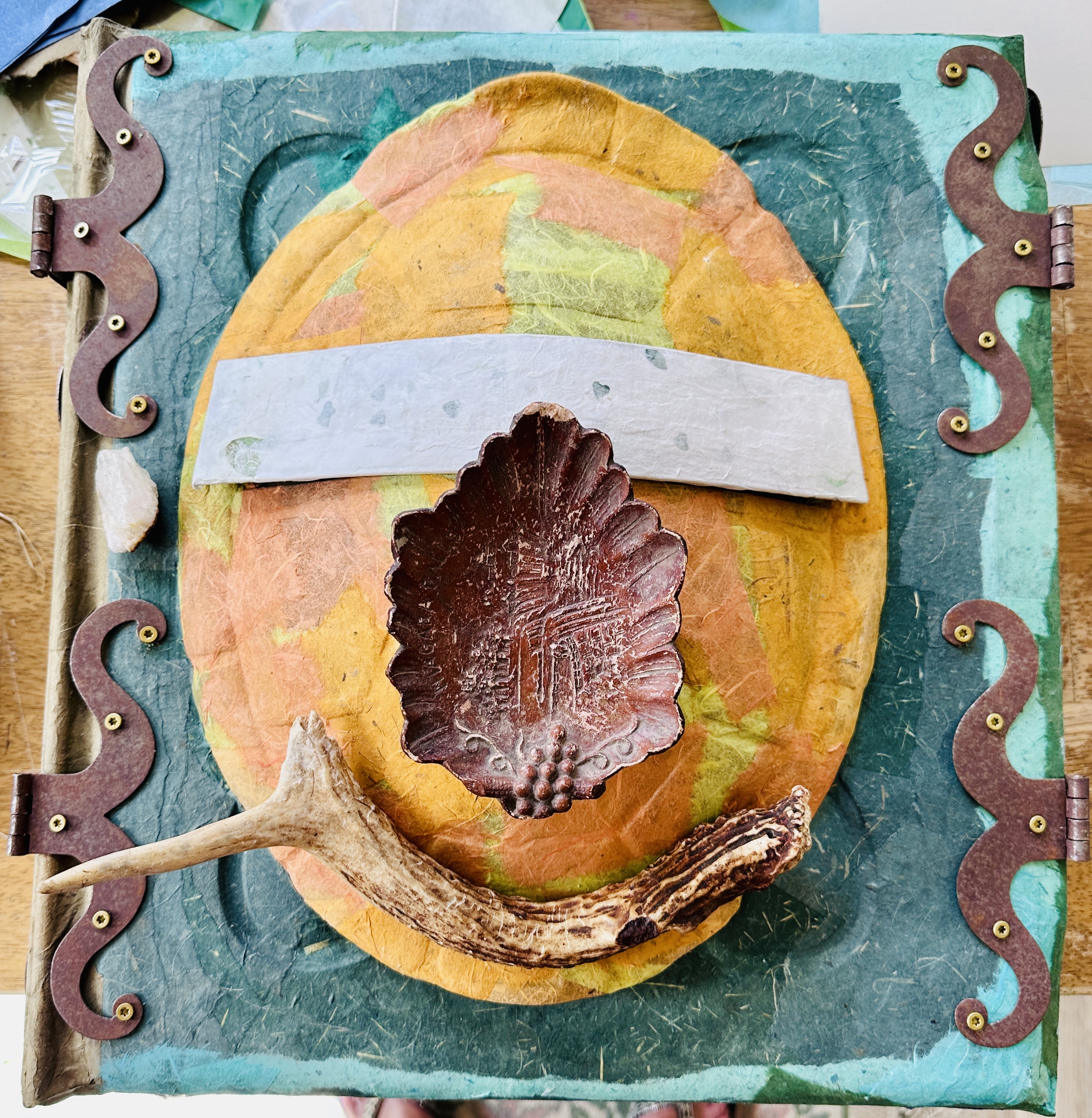 |
| Please upload a JPG or PNG of a picture of you that we can use in the show. We prefer a headshot or something that clearly shows your face. Please make sure it’s high enough resolution for print. |  |
| May we potentially use your work in progress image as part of promotional activities? | Yes, please do. |
| Describe the work including planned media, size and presentation format. (All art forms are accepted for this call, but there must be a physical representation of the work ready for display. Most often this is a framed and ready-to-hang two dimensional image.) | 19.5″ T x 5″ D x 16″ W Gaelic word for book shrine: cumdach (pronounced KOOV-dax) is an elaborately ornamented metal reliquary box or shrine used in Early Medieval Ireland to hold sacred manuscripts and relics. So, that is how morphed from an illuminated manuscript to an illuminated book shrine. I decided to use mulberry paper and found objects to convey the fragile habitat of the natural world around us. I have the piece wired so it can be hung on the wall. However, I wonder it display on a standing display might be better? More like an antiquity. |
| Describe your contemplative practice in relation to the work so far. | I’ve been falling back on my contemplation on Native American thinking: The Washington Park Cottage Connection Rather than meeting at the library, or Starbucks, we gathered at the shelter at Washington Park. As we lingered long after lunchtime, we all gathered snacks from our vehicles and had an impromptu potluck. We were joined by Brittany Flowers from the Christiansburg Institute. She was struck that Washington Park IS a part of Gainsboro AND Burrell Hospital. Playwright David Burnette joined us and his epiphany came the next day. “Miss Janie, the LAND is the narrator!” Holy Cow! Why didn’t I see that before? Now, we have a start. It begins with the sound of drums. The lyrics: Then, again came the caretakers of the land. The story of the cottage is the story of joy of the caretakers and honoring the land, creation with gratitude. It becomes a story of reciprocity. |
| Describe your engagement with nature in relation to this work so far. | “I went down to the ocean-asking her my name When I was a young woman, only an audience with the actual ocean would do for the emotional, cognitive and spiritual renewal I feel commended to seek at times. Even the brackish waters of the bay used to make me feel slightly cheated; so close, yet not quite ocean. Now, thankfully, with age and wisdom, I can find the connection of water from mountain to sea. In service to this project, I have allowed my observation and experience of nature to be where I am….Lick Run Greenway…Kiptopeke State Park on the bayside of the Eastern Shore…Assateague and Chincoteague Islands. Working with Dillard’s work has definitely made me more observant in nature. I’ve enjoyed the site of a snail in its slo-mo, majestic passage. I found a cluster of Ringless Honey mushrooms. For the first time, I saw deer and fox on Chincoteague! It didn’t occur to me they would be there. There was one experience that brought the cruelty of nature to life. I sat outside our RV in the mornings drinking my coffee and using Merlin Bird to identify calls. All of the sudden, there was a tremendous ruckus in the pines high above us. Bird screeched. Squirrel chattered. I never saw the thief as anything more than a blurr. Merlin bird identified a Peregrine Falcon, so perhaps that? The mother squirrel continued ascending high into the tree trying to save her offspring. Finally, she stood on a limb, keening to the sky for a half an hour. That lament was so sad, unjust, unfair to the squirrel- and the same incident was so beneficial to the falcon who perhaps was showing her own progeny how to hunt. I still feel conflicted at life for both predator and prey. |
| Describe your engagement with the text in relation to this work so far. | Not only am I rereading “Pilgrim”, but I am pouring through papers and articles written about it as well. It makes me go back in my mind’s eye to encounters I or my family members had with nature and what those outcomes looked like and what they meant to me. It makes me think how one’s own encounters/observations with nature can inform so much better than warnings from someone fearful. Me-Dillard prays to God through nature. Doesn’t entirely trust God, calling him a “maniac”, “ like a monk on the road carrying a hot coal which doesn’t warm him and which he does not need-but with which he won’t part. She trusts nature…but still sees reflected both beauty and terror. “But ask the animals, and they will teach you, or the birds in the sky, and they will tell you; or speak to the earth, and it will teach you, or let the fish in the sea inform you.” |
| What questions, or primary question, have arisen for you in pursuing the work so far? | The primary question was about dedicating the Book Shrine to a saint, tying the work to my ancestral heritage and spiritual practice. This was not so very difficult. This was Kateri Tekakwitha, Mohawk woman (Father was a Mohawk Chief, mother was Catholic Algonquin) and the first Native American Saint in Catholicism. My Mother’s family would travel in the summer to spots all over the eastern U. S. A. and Canada to visit the homes and families of venerated Catholics. This relic had come from their journey in the 1950’s to Fonda, NY. to meet Fr. Thomas Grassman, Franciscan Friar and founder of the Fonda Memorial Shrine of Catherine Tekakwitha. Here, the saint lived most of her life in the late 1600s. Within the Catholic faith, she is the patron saint of Native Americans, the environment, nature, ecology and ecologists. In my Mother’s travels in the 50’s, she would often see “Indians” in little villages in Canada, upstate New York and Florida. The narrative I received from her about Native Americans was always what a beautiful people they are and what a raw deal they received from colonization. I became a fan of Kateri that day, even taking the name “Kateri” as my Confirmation name years later. It is, of course, not lost on me that Kateri’s baptism into Catholicism was and is a part of the colonization of the First People. For me, because of the faith, I was exposed to Kateri and she definitely influenced my interests in Native ways, the environment, nature and Fourth World knowledge. She’s the guidepost that led me to Rachel Carson and Jane Goodall and Lawrence Anthony. |
| What have you learned in the process so far? | Highest self (me) To me, bringing one’s highest self is thinking with one’s soul, which is linked spiritually with all creation and the Higher Power. It centers nurturing one another to the greater good. The higher self makes decisions and engagement guided by love, abundance and bringing about the greatest fruition of our ancestor’s wisdom and dreams. It is unencumbered by ‘ego’. Ego makes decisions and engagements based on fear, lack, scarcity, greed (for money or fame or “being right”) and self enrichment. |
| If applicable, please describe any challenges that will prevent you from participating in the effort or completing the project on time. | NA |
| REQUIRED: Please add a PDF of your vendor’s invoice here. The payer is “City of Roanoke, Attention Douglas Jackson.” This invoice is required and may be generated from your accounting system or manually created. The invoice must be numbered and all information must match what you have entered in Oracle. | Pilgrim-Invoice.pdf |
| Invoice Number | OW-0904-Pilgrim |
| My typed name stands for my signature. I have identified all technology used in the creation of this work in the description of my process above. | Jane Gabrielle McCadden |
| Staff use only | DCJ -Okay to Pay |
| Staff Use Only: Melissa Tracking | Paid ACH 10/18/2025 |
•
•