| Name | Natalia Michel |
|---|---|
| Phone | 540-529-7254 |
| Email hidden; Javascript is required. | |
| Name of Work | Negative Space |
| Please upload a JPG of your COMPLETED work. | 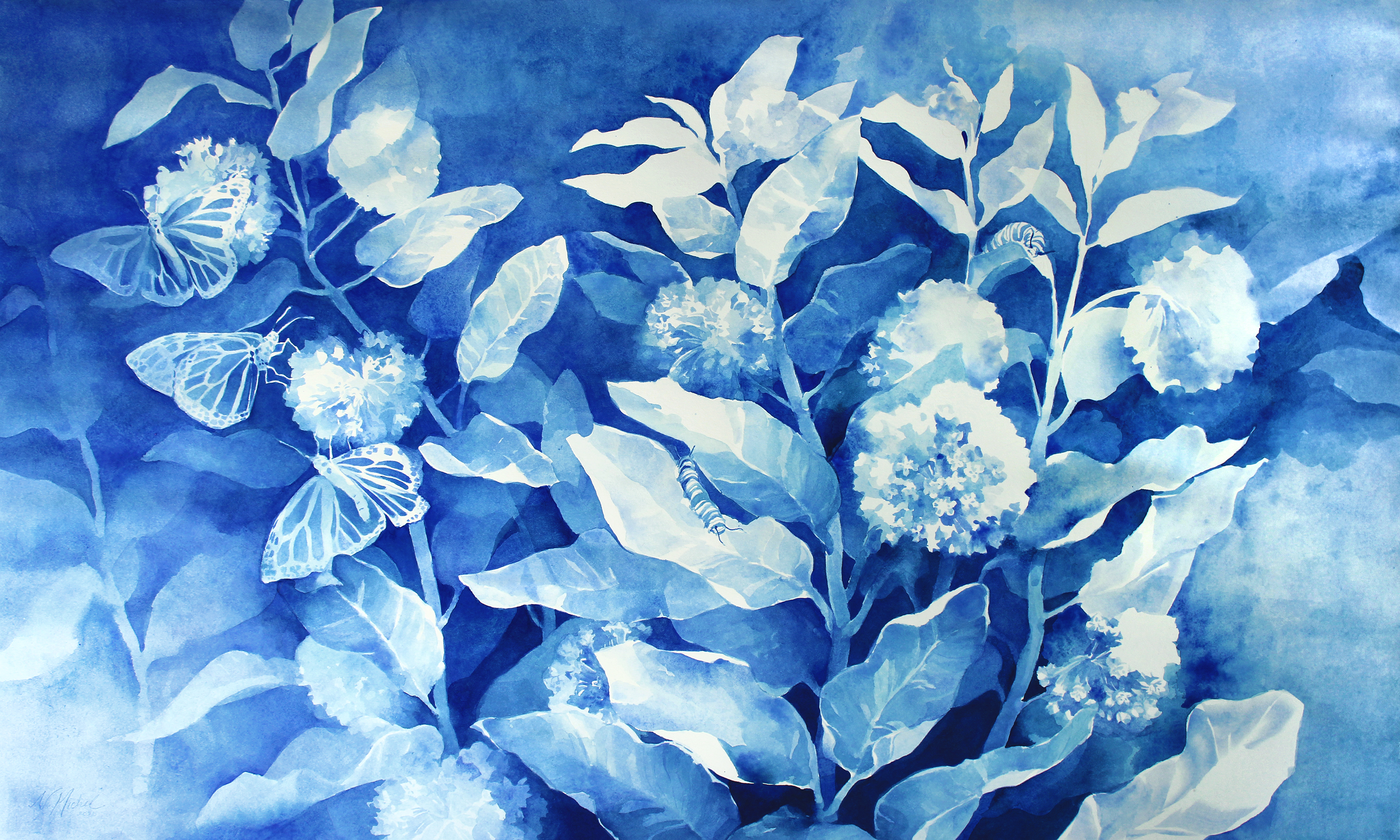 |
| Describe the completed work, including media, size and presentation format. (All art forms are accepted for this call, but there must be a physical representation of the work ready for display. Most often this is a framed and ready-to-hang two dimensional image.) | 30 x 18in. This painting delves into my anxieties about ecosystem collapse, specifically the widespread death of insect populations. Here, monarch butterflies and caterpillars perch and feast on a native host plant, common milkweed. The limited palette is inspired by cyanotypes, with their deep negative space and ghostly, ethereal imprints of the subjects. Drawing from a mode highlighting the visual weight of what isn’t there felt appropriate for contemplating the missing hordes of migrating butterflies described in ch. 14 of Pilgrim at Tinker Creek, a phenomenon I didn’t even know had once existed in our area before reading the book. Nature’s admirable stubbornness exists in many, mostly tiny creatures, doing their best to survive. Adopting a macro perspective, blurring the subjects into formless background, the piece can be read from either left to right. Butterflies and their delicate, tenacious progeny moving into the future, or successive generations of caterpillars destined to be fewer than their predecessors? |
| Please reflect on how your contemplative practice informed or helped shape the work. | I’ve had some version of this piece in mind for a while, and now feels like the right time for it. I’ve spent this year observing my garden as usual, alarmed at how few insects I see. I’ve been reading news regarding the worldwide collapse of the insect population for a few years, and seeing it in miniature on my small property feels quite bleak. However, I’m quite practiced at putting my foot on the doom-spiral. I keep adding native plants and learning as best I can to be a good steward to my corner of the world, daydreaming of bigger projects and what it would take to build them into reality. Even if on some over-arching, mathematical metric, it doesn’t make much of a dent, I still believe it’s worth it to be a nuisance to our problems while we’re still here. |
| Please reflect on how your deeper exploration of nature informed or helped shape the work. | I’ve wanted to paint common milkweed for a couple of years now, after observing a probably 3ft. square patch growing incongruously on a median on Melrose Ave. I passed by it several times that summer, surprised and delighted to see that no one had removed it, see it bloom and thrive, such as it was. To my knowledge, it didn’t return in following years. But I think of it often as an act of chance defiance, and implicitly, compassion. Someone was clearly mowing around the patch, and chose to let the flowers stay. Nature as we have known it will not save itself; death is widespread and already here. But nature’s creatures are also very, very stubborn. I keep hope in my heart for the tenacity of countless unseen lives and that we will witness their descendants. I am heartened to see more discussion and awareness of native plants and insects, and the monarch butterfly is becoming something of a poster child for insect conservation, like the panda is for mammals. In future works I’d like to highlight more niche critters, but monarchs are perfect for this one, as common milkweed is one of their host plants, long considered an aggressive nuisance by many people. |
| Please reflect on how your engagement with the text of PILGRIM AT TINKER CREEK informed or helped shape the work. | The most lasting effect of reading Pilgrim at Tinker Creek is how it’s broadened my perception of nature, and life broadly speaking. In the past, my gut reaction to learning of the effects of climate change etc. was to yearn for some prior era where none of this was a problem, or as big of one, if only we could go back. It would be lovely, but nature has also never been static. The death humanity has visited on ourselves and the rest of nature’s creatures is real and requires mourning, but the book helps me, in many small moments, to come to terms with and hope for a future in which some version of us limps out of it, transformed but still here. |
| What questions has this work prompted you to explore next? | I still continue to wrestle with how I can show the beauty I see in flowers and nature’s creatures without romanticizing them overly much. But the unexpected inspiration and the aesthetic limitations it necessitated really interest me and I’ll be thinking on it for the future. |
| What did you learn in the process? | That nothing you do is truly for nothing, and a reminder that art is cumulative, though nonlinear. I initially planned a much broader pallette, but while I was confident in my composition, something felt off, it wasn’t connecting. Rather late into the process, I was struck unexpectedly by a spark of inspiration while searching through piles of previous work for something completely unrelated: pressed flower cyanotypes. It was a fun pet project to satisfy a curiosity a couple of years ago, which I enjoyed but didn’t do anything much with. Yet it was the perfect fit conceptually and elevated my painting in the way it needed, making the execution much more fun as well once I wasn’t floudering for clarity. |
| This is an original work and I have identified all technology used in the creation of this work in the description of my process above. My typed name stands for my signature. | Natalia Michel |
•
•