| Name | Dan Kuehl |
|---|---|
| Phone | 5409157336 |
| Email hidden; Javascript is required. | |
| Name of Work | "Reach" |
| Please upload a JPG of your COMPLETED work. | 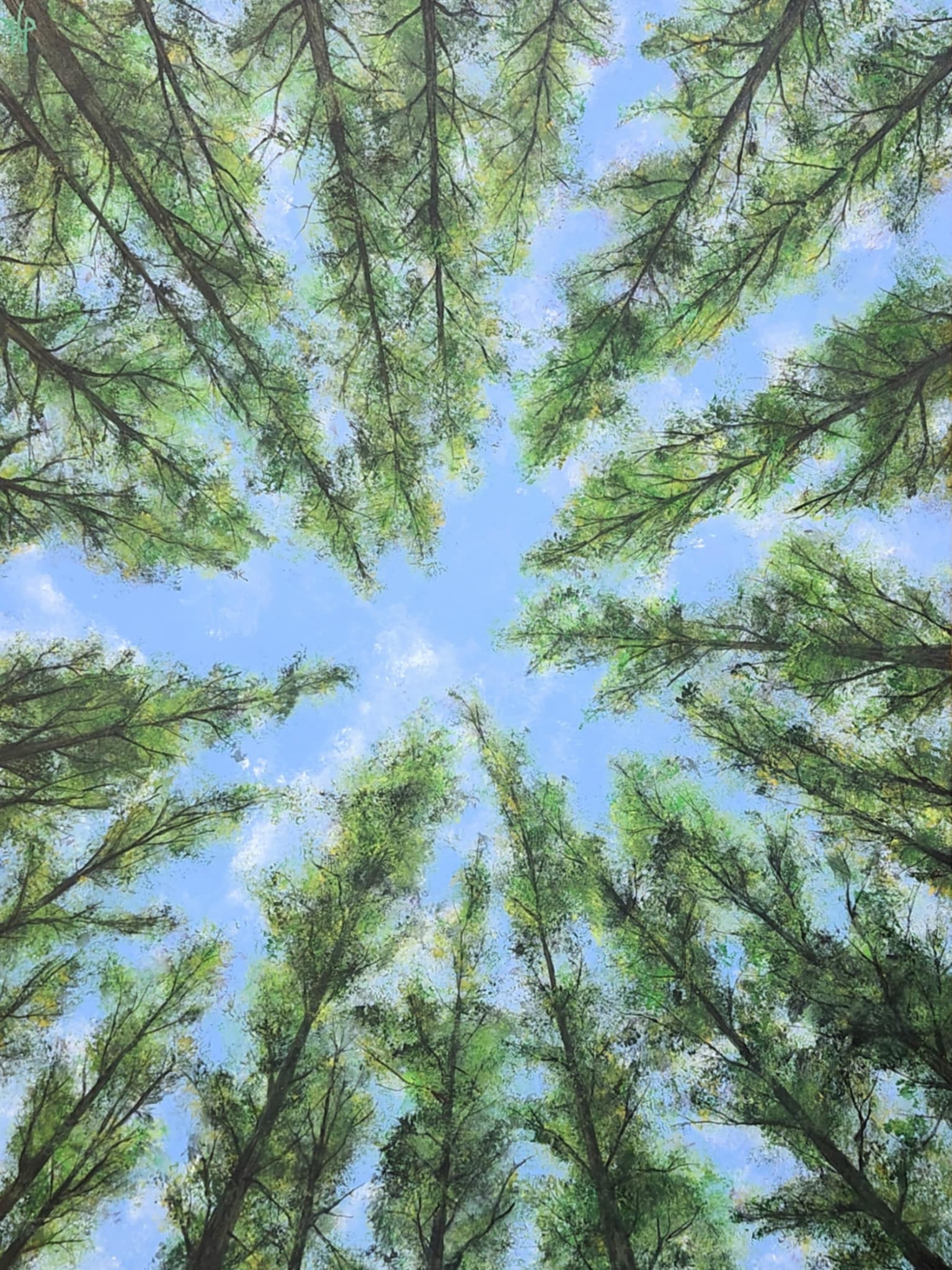 |
| Describe the completed work, including media, size and presentation format. (All art forms are accepted for this call, but there must be a physical representation of the work ready for display. Most often this is a framed and ready-to-hang two dimensional image.) | The piece I created for this show is an acrylic painting on canvas. It is 24″ x 36″, and it is meant to be hung on the wall. Instead of using brushes, I applied most of the paint with a natural sponge and I used a long thin brush to paint the branches. |
| Please reflect on how your contemplative practice informed or helped shape the work. | I spent some time looking through my own photos of times when I was out in nature, and I found beautiful things and tried to capture them in a photograph. I came across a lot of photographs where I was trying to capture how light played a dramatic part in the feeling of the moment. When I see these moments of light play, I know that the moment is one of a kind, and it is fleeting. I try to capture it right away, as it may be gone shortly after the photo is taken. It makes me realize that life is full of noticing fleeting moments and we should enjoy them before they change! |
| Please reflect on how your deeper exploration of nature informed or helped shape the work. | I love being in nature, and I love seeing the little details that could easily be overlooked. I can imagine adding more of these moments of nature into my own artwork. |
| Please reflect on how your engagement with the text of PILGRIM AT TINKER CREEK informed or helped shape the work. | In the second chapter Pilgrim at Tinker Creek, Annie Dillard talks about a book she once read titled, “Space and Sight” by Marius von Senden, where people can see for the first time, due to having eye surgery after having a life of blindness. Their sight is overwhelming to them, and depth and color and shadows can be confusing. Light shining through trees seems more like a “tree with lights in it”. This confusion about what is going on seems like an error to most, but to Dillard, it seems desirable. Instead of understanding everything about what we see, we can experience what we see without first understanding it. In this, she says it is, “less like seeing than like being for the first time seen.” One day, as I was in a forest looking around at my eye level, I saw the earth, small plants, and trunks of trees. When I looked up, there was something different. There was motion. Trees were reaching up and playing with the sky’s colors. The light danced in the openings between the trees, and the endless depth of seeing our atmosphere had been replaced with color and light, and trees were not closer than the sky to me, but rather, touching and engaging with the sky, with its blue gradients and white clouds which give no evidence of any depth at all. At once, everything seemed both far away, with very tall trees, and close, with a sky that could just as well be right on top of the trees. |
| What questions has this work prompted you to explore next? | I want to find more places where experiencing nature gives me feel awe and wonder, and see if I can translate that into images for others to feel the same connection. |
| What did you learn in the process? | I realized that I have long been fascinated with fleeting moments in nature, like sunlight on leaves or flowers, and I have taken many photographs of these moments. I could take these photographs and use them as a reference for creating paintings or drawings. It takes the moment I capture, and stretches it out to let me be immersed in it. |
| This is an original work and I have identified all technology used in the creation of this work in the description of my process above. My typed name stands for my signature. | Daniel J. Kuehl |
•
•