| Name | Jane Gabrielle |
|---|---|
| Phone | 5403975126 |
| Email hidden; Javascript is required. | |
| Name of Work | "Celtic Book Shrine" is dedicated to Saint Kateri Tekakwitha , patron of Indigenous Peoples, the environment, and care for creation. |
| Please upload a JPG of your COMPLETED work. | 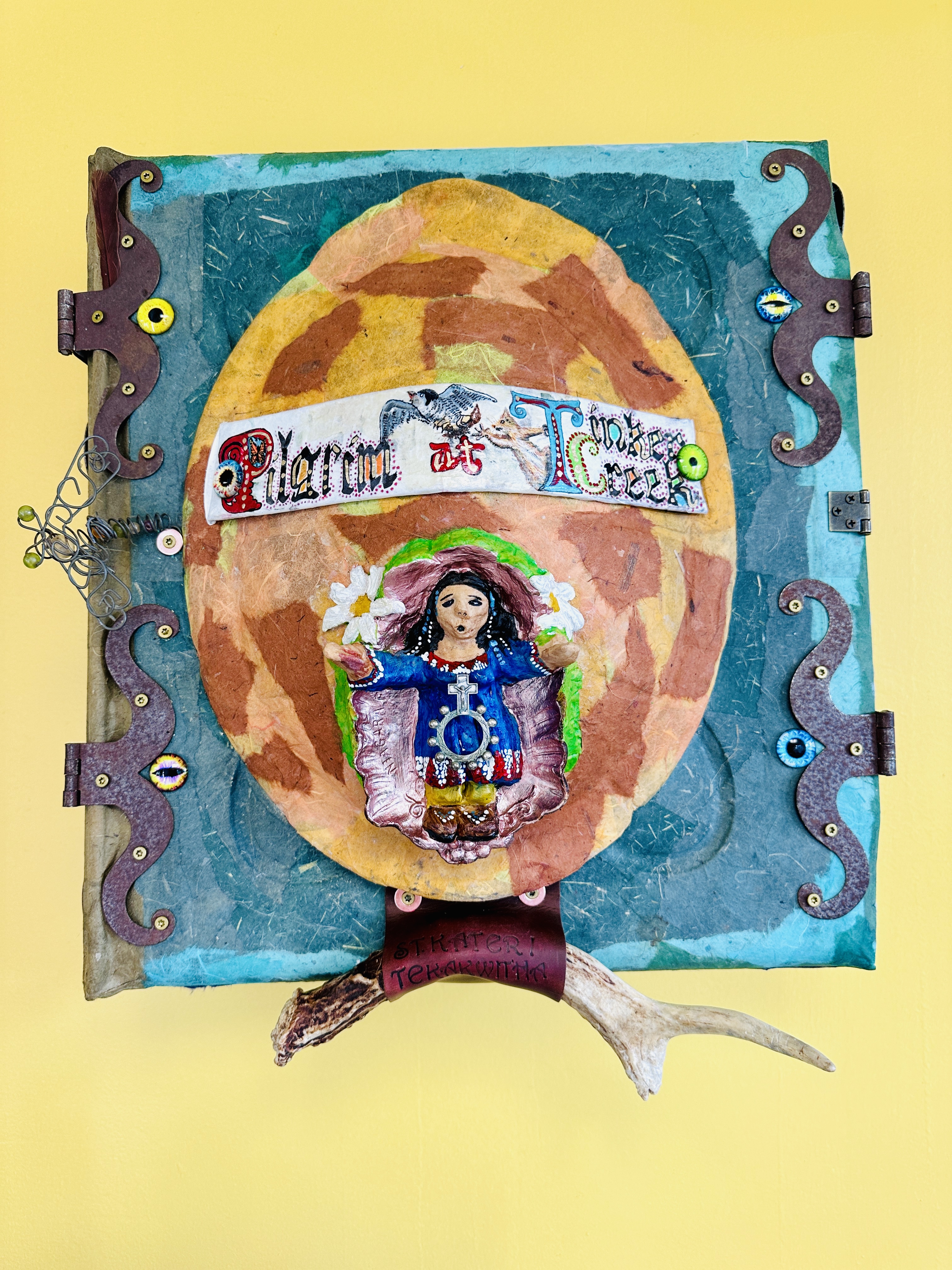 |
| Describe the completed work, including media, size and presentation format. (All art forms are accepted for this call, but there must be a physical representation of the work ready for display. Most often this is a framed and ready-to-hang two dimensional image.) | 17.5″ w x 18″ t x 4″ w |
| Please reflect on how your contemplative practice informed or helped shape the work. | A part of my contemplative practice is to make space to hear my ancestors speak to me and through me for the work. One part I struggled with was locating the niché for Saint Kateri. I needed just the right size wooden “dish” to float into a hole I would create in the turtle shell. After exhausting usual inspirational outlets (Goodwill, Black Dog, Habitat) my ancestor practice led me to a wooden souvenir coin dish my grandparents brought back from their honeymoon in 1938 at Niagara Falls! I was able to screw through the dish and also create the Kateri figure onto it. This felt like a collaboration with spirit. It was during this trip that my grandparents first learned of Kateri and the hope to have her one day canonized in the Catholic Church (she was canonized 74 years later in 2012). The couple returned with their children, my aunt and Mother, in 1948 and visited the village Kateri was from and the shrine dedicated to her. My fascination with the story drew me to consume all I could about Indigenous spirituality and that also led me to doubt Catholicism, or any organized religion, where dressed up white people alternately sit, stand and kneel, dirging their way through “Faith of Our Fathers”. I am deeply aware there is a conflict in celebrating Saint Kateri because of the history of the missionary church and schools and the erasure and torture of Indigenous peoples. This quote sums it best: Perhaps it is the Indigenous invitation to “dance and sing in true joy” that sums up what I ache for in spiritual practice with other humans. Perhaps it is the honoring of women and their importance. I’d like to comment on the illuminated title. I have studied lettering, calligraphy, ancient scripts, Book of Kells. I’ve been obsessed with lettering since I was about 9 when my Mother shared an album her Uncle Phil had illuminated for my grandfather’s birthday. Uncle Phil was a Redemptorist priest, a missionary in Puerto Rico, an avid horseman and a talented artist and singer. I never met him. He died in 1950. I have used that illuminated album as a guidepost. He has been a teacher to me, from spirit, all these many years. |
| Please reflect on how your deeper exploration of nature informed or helped shape the work. | I have reflected earlier on the heightened attention to nature and some of the drama I noticed. The Peregrine falcon swooping away with a mama squirrel’s baby shocked me and at once made me aware of the empathy we should share with Mothers across nationalities and even across species. I included a depiction of the encounter on the title banner. I’m holding “Art-n-Soul Club” at Villages of Lincoln for elementary and middle school kids. As we were painting outside last week, two kids started screaming bloody murder! It turns out there was a praying mantis beneath the table. They had no idea what it was. I’m excited to tie art in with nature. Species are counting on us. To stop spraying poison, to stop the deadly march for perfect lawns, to stop bagging leaves! Thus, in a way, they are watching us. I included various animal eyes as gems on the piece. The discovery of the eyes as a secondary “gotcha” by the viewer perhaps could be a “wake up call” to the viewer. The North American continent is called “Turtle Island” by Indigenous peoples, thus the turtle shell. Some Native tribes ascribe a lunar calendar to the turtle’s shell with 13 moons and 28 day cycle. There are days I am completely overwhelmed at the sense of loss I feel from the desecration of wildlife. Returning to Roanoke from North Carolina on Rt. 220 last month, we came across a bear – just hit. The small car was off to the left and people stood about. The bear lay in the middle of the right lane. She was a beauty, close to 500 pounds. As I gazed out the passenger window, I looked directly into her coal black eyes. Her spirit was gone. I cursed the drought that likely brought her down the mountain. And I cursed mankind. It was Sunday. Traffic was light. How do you not avoid a 500 pound bear!? But every day, smashed grey carcasses pave our roads. I murmur “wake up my love, wake up” at each one to practice empathy lest I become jaded to the loss. |
| Please reflect on how your engagement with the text of PILGRIM AT TINKER CREEK informed or helped shape the work. | “I am the skin of water the wind plays over; I am petal, feather, stone” Think about that! “The skin of water”?! We are 60% water! From my Syllabus for Carillion Healing Arts: * Sitting under a sycamore by Tinker Creek, the author considers the idea that one purpose of humanity is to help “hallow” the things of creation. I particularly like this concept and returns me to the question of “what if everything is sacred?”. To go back to the Bible: Dillard prays to God through nature and doesn’t entirely trust God, calling him a “maniac”, “ like a monk on the road carrying a hot coal which doesn’t warm him and which he does not need-but with which he won’t part. She trusts nature…but still sees reflected both beauty and terror. |
| What questions has this work prompted you to explore next? | The self-inflicted torture that Kateri Tekakwitha subjected herself to is shocking. Another piece of Catholicism that confuses me is this elevation of self-torture. I think it is unhealthy and likely a trauma response. Nothing about this practice is “self-care”. Perhaps a series that celebrates self-care, but in a church hierarchy. “The Fourteen Stations of Self-care”. My Mother had a kitchen Madonna that depicted Mary in house clothes, a broom in her hand with (blonde-haired🙄) toddler Jesus at her feet reaching up for her. Why not celebrate healthy family patterns rather than the Pieta image of the bloody, dying Jesus in Mary’s arms? |
| What did you learn in the process? | I learned leatherwork is harder than it looks. I learned that applying animal paws to the work makes the work gruesome. I learned (again) that I want to understand my own Indigenous heritage. What did my Irish ancestors do at the time of the Book Shrine. What did the forests look like then? |
| This is an original work and I have identified all technology used in the creation of this work in the description of my process above. My typed name stands for my signature. | Jane Gabrielle |
•
•