| Name | Ashley Wilson Fellers |
|---|---|
| Phone | 5403556038 |
| Email hidden; Javascript is required. | |
| Name of Work | Tinker Creek Greenway: Lines and Liminal Spaces |
| Please upload a JPG of your COMPLETED work. | 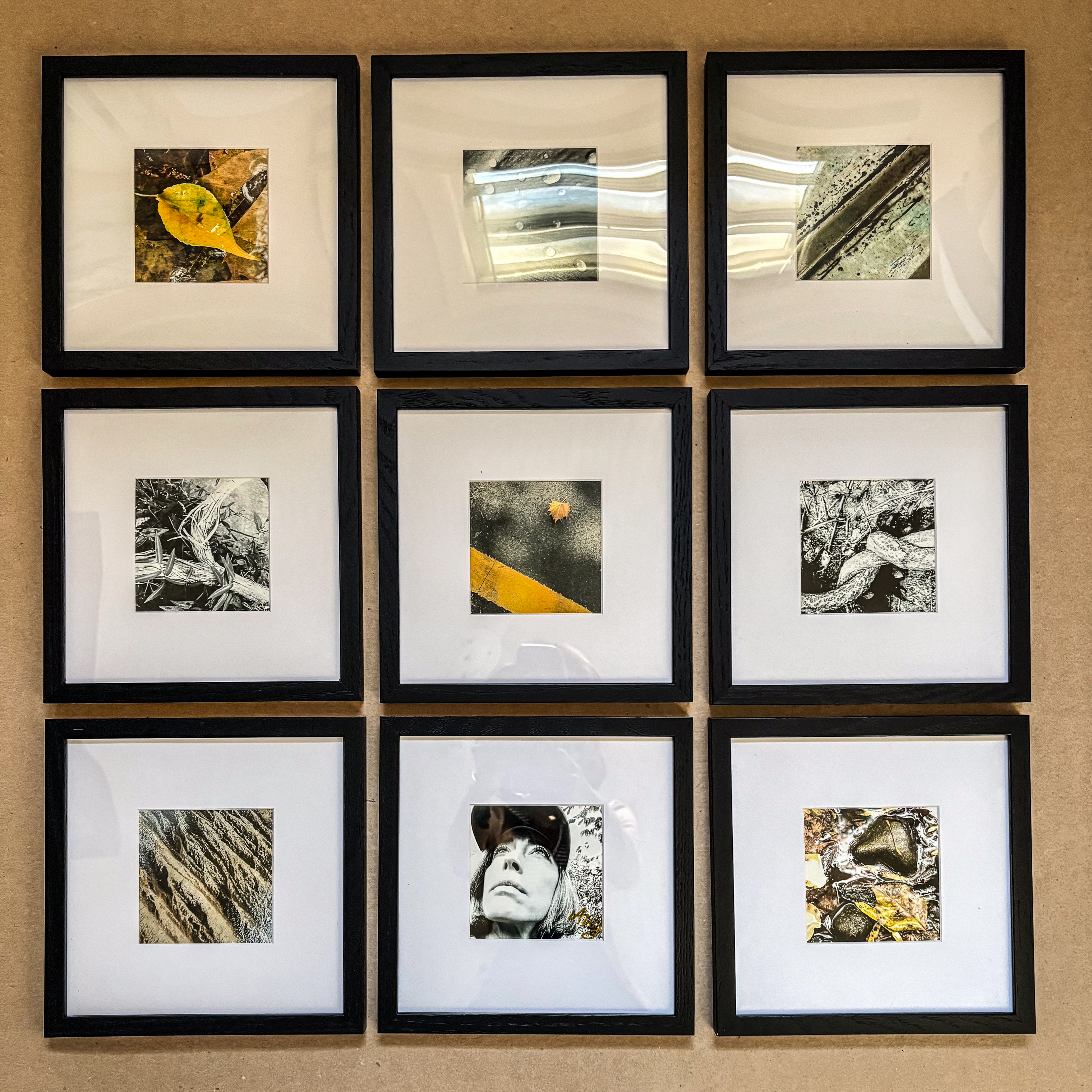 |
| Describe the completed work, including media, size and presentation format. (All art forms are accepted for this call, but there must be a physical representation of the work ready for display. Most often this is a framed and ready-to-hang two dimensional image.) | This work is a collection of nine contemplative photographs, taken from my time in and around Tinker Creek, and on the Tinker Creek Greenway. Each image was captured by the simplest camera I keep on hand – my iPhone – lightly edited right within Apple Photos, and then cropped to 4 X 4 inches in a simple, clean-lined 9” gallery frame. Together, the images make up a miniature gallery that – I hope – reflects the tension points formed by the Greenway, its visitors, and its surroundings. I explore juxtapositions between the built world and the natural one, as well as water and stone, soft leaves and hard asphalt, sinuous curves and strong lines. Through it all, I’m particularly gratified that I was able to build this work using tools that just about all of us keep in our pocket … and I love that I used technology – which so often invades the contemplative mind – in service to mindfulness. |
| Please reflect on how your contemplative practice informed or helped shape the work. | I’ve spent years playing at contemplative photography. I say “playing” on purpose, because play, to me, is the heart of a healthy mindfulness practice: a sense of light-handed, open-hearted, joyful curiosity. A contemplative photographer is willing to receive rather than to capture. Her job, if we can call it a “job,” is simply to show up, expecting to be astonished. This feels in direct conflict with many artistic practices, which are about working and making rather than playing or discovering. And so, in this way, I felt a challenge to bring something new into this creative call. On the creek, I resisted the urge toward complexity. I didn’t sketch, didn’t plan, and didn’t use my bigger camera or even my usual editing software. Instead, I stuck to the most accessible technology possible, and I simply arrived at the Greenway whenever I had a little extra time or just needed some empty air, toting my iPhone in my pocket. The photographs presented themselves to me everywhere. Every image was a gift. |
| Please reflect on how your deeper exploration of nature informed or helped shape the work. | One of the most elusive subjects I followed in my journey along the creek was a yellow-crested night heron, who seemed to materialize out of the mist during multiple visits. She doesn’t appear in this grid, but she *did* appear in the painting that almost took its place. And somehow, I see her in this collection of images, too. It was in researching her – her habits, times of activity, preferred foods and migratory patterns – that I found myself showing up at the creek at last-light, in hopes of glimpsing her again. And while she ultimately eluded my camera – her images were soft-focused, blurred – she also led me into many of the “happy accident” images that you see here. Which is the magic of contemplative photography: the chase leads us not to a place where we capture an image, but to a place where we *receive* image we couldn’t have planned. |
| Please reflect on how your engagement with the text of PILGRIM AT TINKER CREEK informed or helped shape the work. | I loved Pilgrim, just as I loved Walden when I was a younger woman. Dillard’s words found me when I needed them – this time as a middle-aged adult – and they called me back into the contemplative life. For that I’m grateful. But one thing that continues to trouble me in Dillard’s work is her impetus to erase her surroundings from the creek … to stylize and romanticize her suburban neighborhood until it simply slips out of the frame. Thoreau had this impetus, too. I didn’t want to do that here. For me, the magic of the Greenway – and of a good contemplative practice in general – is that it invites us to lean into dissonance and tension, in this case between the human and the natural worlds (if they can be said to be in opposition at all). In fact, over the course of my journey on the creek, I found myself deliberately seeking these contrasts, as well as the broken or the ugly or the disordered … going there (exactly there!) for real beauty. So, I explored the creek’s quiet shallows, and I found tiny whorled shells no bigger than my pinky nail, and fluorescent-hued flowers spangled with raindrops. But also, I found messy knots of flood debris, graffiti scrawled on the undersides of bridges, and invasive tangles of autumn olive. And these invited me not to shy away, but to look closer … to crop the frame tighter, and to gaze through until something deeper appeared. I’m crossing my fingers that this shows in the final work. |
| What questions has this work prompted you to explore next? | This project represents my first attempt to group multiple contemplative photographs into a larger arrangement. In the process, I discovered I could create a space for the disparate images to converse. I was deliberate about how I placed each image: not just the alternating pattern of monochrome positioned against color, but also the juxtaposition of natural subjects with human-made ones, and broken things contrasted with knitted-together ones. I placed myself in the grid, too: in the lower center row, downstream from everything else, in a position of receiving. And now I’m feeling fascinated by the possibilities that arrangement opens: Can I tell a story through contemplative photographs that leverages their positions in relation to one another as a core narrative structure? I’m imagining a series of photographs ordered in a long, single, meandering line, curvaceous as a creekbed, or switchbacked like a trail, and hung against a dark wall, simply lit. In this way, could I invite a viewer to explore a new place with me – a park, a creek, a path – by collecting images over time, and by presenting them as a journey that **plays** in points of dissonance? Could this be a new way I explore, interrogate and celebrate a landscape? I think it’s possible. |
| What did you learn in the process? | A little voice kept rising unbidden throughout my journey: keep it simple. Perhaps it was my modern revocalization of Thoreau’s well-trod advice: “Our life is frittered away by detail… Simplify, simplify.” For me, this contemplative journey was about letting go of the ambition to create something challenging or complicated or hard. Instead, I felt a call to show up simply, and to receive with delight. When I did so, I found these nine photographs …and it felt not like striving, but like floating, leaflike, down a stream. |
| This is an original work and I have identified all technology used in the creation of this work in the description of my process above. My typed name stands for my signature. | Ashley Wilson Fellers |
•
•